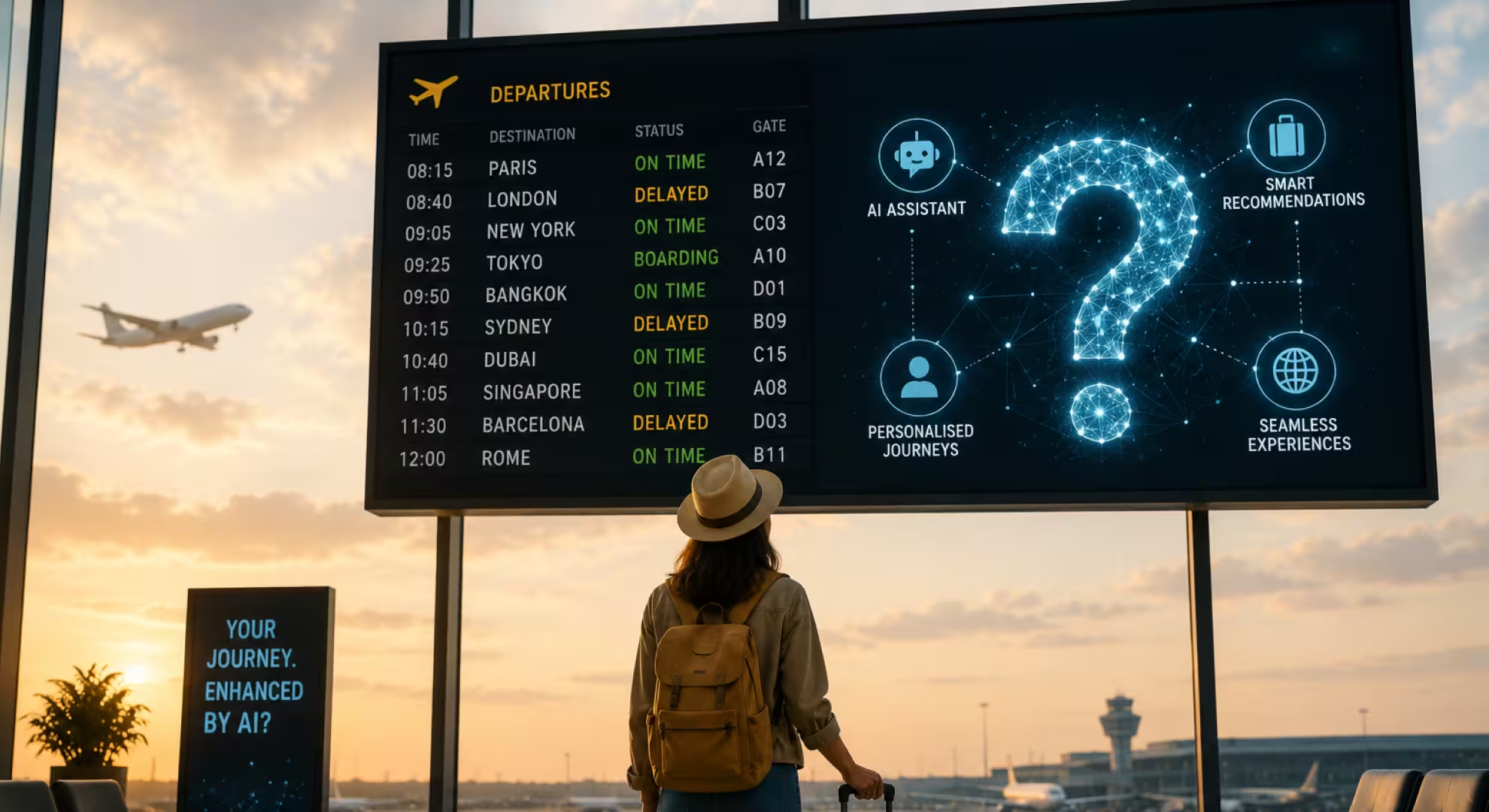
A recent Skift article found that 80 percent of travel executives are building AI booking agents, while 2 percent of travelers want to use one. That 78-percentage-point gap will not close on its own.
It is not inherently the technology that is the problem. It is that the industry is racing to build agentic AI without building, or at least openly talking about, the things that make it trustworthy. Travel is not a $10 meal delivery. It is a family holiday, a honeymoon, a business trip where missing a flight means missing a deal; trust is intrinsically woven into every travel purchase. Travelers want more than a seamless experience; they want certainty and accountability if something goes wrong.
In our experience, closing that gap comes down to four things: evaluation, decision logs, accountability, and specificity to the individual.
Evaluate the outputs, not just the inputs.
AI is only as trustworthy as the infrastructure that checks it. In Sherpa’s case, government travel requirements change constantly, often with little notice. Our update process is three-pronged. AI enables us to proactively monitor updates at scale, but each update is then verified through relationships with over 360 governments and a human-in-the-loop to corroborate the change.
AI then updates the system, enabling us to deliver changes to travel requirements and visa documentation as close to real time as possible. Even these updates are continuously evaluated, testing AI outputs against known correct answers to spot hallucinations early. Every AI agent we deploy responds only from controlled, up-to-date context rather than general training data. This is called grounding, and it is what prevents a system from inventing requirements that do not exist or from presenting outdated information as fact.
We’ve found a balance between speed, scale, and accuracy with our evaluation process, and it seems to be working. We update requirements faster than any competitor 92 percent of the time and can stand behind the accuracy of what we publish.
In a sector where bad information means a denied boarding or a wasted application fee, hallucination is not an edge case. Evaluation, at every data layer, is the first line of defense.
Log the decisions.
When something goes wrong in a human-advised booking, there is a trail. An agent said something at a specific time, based on information available at that moment. That traceability is what accountability rests on. AI systems need the same.
PhocusWire argued recently that the moats OTAs built on, brand trust and loyalty, may not survive the agentic shift. But arguably, they’ve set the baseline for the expectations AI has to meet. Furthermore, there’s an argument that loyalty may be a decider: if all travel operators roll out AI agents, wouldn’t you assume the company you’ve trusted for years will do it best?
AI can feel like a black box, with limited transparency around how decisions are made and why. Every response from our LLM endpoint includes source citations and timestamps, so agents and travelers can check what was recommended, when, and against which data. If a requirement changed after a booking was made, that record shows it. If a traveler received incorrect guidance, you can see exactly why.
Most AI systems in travel today put accountability in the terms and conditions instead. The AI surfaced information; what you did with it is your responsibility. That is a reasonable legal position. As a trust-building strategy, it falls short.
Design accountability in, not out.
Under the EU AI Act, any AI system where decisions meaningfully affect individuals must offer a path to human review. For travelers dealing with unusual document requirements, complex itineraries, or edge cases no training data covers, that means a real person to escalate to. Our own AI chatbot works this way by design. It answers common questions, shows application status, and provides the requirements relevant to their trip. When it reaches its limit or a traveler requests a person, it creates a support ticket that is routed directly to a human agent.
When errors do happen, we stand behind our customers and work to make it right. For travelers who want an explicit safety net, our reapply protection lets them claim a free reapplication if something goes wrong; escalations are handled by a human, and the AI steps discussed earlier help the conversation run smoothly. The airlines and OTAs building trust in the agentic era are taking the same approach: building the human handoff in from the start, and prepared to stand behind the outcome when their AI gets it wrong.
One question we ask ourselves about our agentic flows is: where’s the hard stop? Where do we not trust it to go, or believe the guardrails aren’t in place? For us, read-only is a design choice, not a limitation.
Our LLM layer surfaces requirements, documents, and timelines. It cannot initiate an application or make a booking on a traveler's behalf. The personal data in a visa application- passport details, travel history, personal circumstances- is sensitive enough that routing it through an autonomous AI layer without explicit human confirmation introduces risk we are not willing to take. The traveler retains control over that decision.
Get specific to the traveler.
AI can learn a great deal about an individual traveler and tailor its responses accordingly. The level of specificity it can achieve at scale is what agentic travel AI wants to harness. Its ability to personalize an experience is where agentic AI’s strengths sit today; what it can’t yet do is account for taste- that’s the human layer still.
For us, specificity means surfacing the right requirements for the right trip: the traveler's passport nationality, destination, travel dates, and the platform they are booking through. It means an API structured so that AI agents, LLM chatbots, and partner booking flows can query it and receive a response relevant to that traveler. Several of our airline and OTA partners already use this to power their own AI chat experiences, surfacing visa and entry requirements in context without requiring travelers to leave their platforms or search elsewhere.
The same specificity applies to the application itself. We pre-fill visa applications using the traveler's verified passport data, so they can review and confirm accurate information rather than type from scratch. Our AI checks every photo against each destination country's specific requirements, catches problems before submission, and guides the traveler to fix them in plain language. The result is an application flow that is 20 percent faster than applying through a government portal, with a 99.1 percent application approval rate.
Build trust transparently at the data layer.
The travel companies that earn a place in the agentic future are not necessarily the ones building the most sophisticated booking agents. They are the ones transparently building the infrastructure that makes those agents trustworthy. Openly sharing how they’ve accounted for: data accuracy, grounded responses, logged decisions, clear accountability, and outputs specific enough to give a traveler the confidence to act.
The race to automate is real. As an AI-supported product, we are part of it. What we have learned is that the automation that moves the industry forward gives people better information to make high-stakes decisions faster, with more confidence, and without the friction that makes travel planning feel like a second job.
Travel's agentic AI era demands more accountability, not less; that’s what will bridge the gap between agentic AI and consumer sentiment.


.avif)